Santa Muerte prayers for beginners are simple devotional prayers used by followers of Santa Muerte, also called La Santa Muerte, Santissima Muerte, or the Holy Death. Beginners often start by speaking sincerely, asking for protection, guidance, health, or help during difficult situations. There is no single universally recognized prayer book or formal liturgy for Santa Muerte devotion; practices vary among devotees and communities.
If you are new to this tradition, you do not need an elaborate altar or complicated ritual to understand its basic prayer practices. Start slowly, learn the cultural and religious background, and treat traditional practices as devotional customs rather than guaranteed ways to produce supernatural results. This guide explains common prayer forms, beginner-friendly original prayers, novenas, offerings, and important distinctions surrounding Santa Muerte devotion.
What Is Santa Muerte?
Santa Muerte is a skeletal female figure associated with death, protection, healing, justice, and other forms of assistance in popular religious devotion, especially in Mexico and among Mexican and Mexican-American communities.
Her modern public devotion became increasingly visible during the twentieth century and expanded rapidly in the early twenty-first century. Scholars describe Santa Muerte devotion as a diverse and developing religious movement rather than a tradition with one universally accepted theology or ritual system.
The figure is often called La Niña Blanca, La Flaca, or La Santísima Muerte, although names and meanings can differ between devotees.
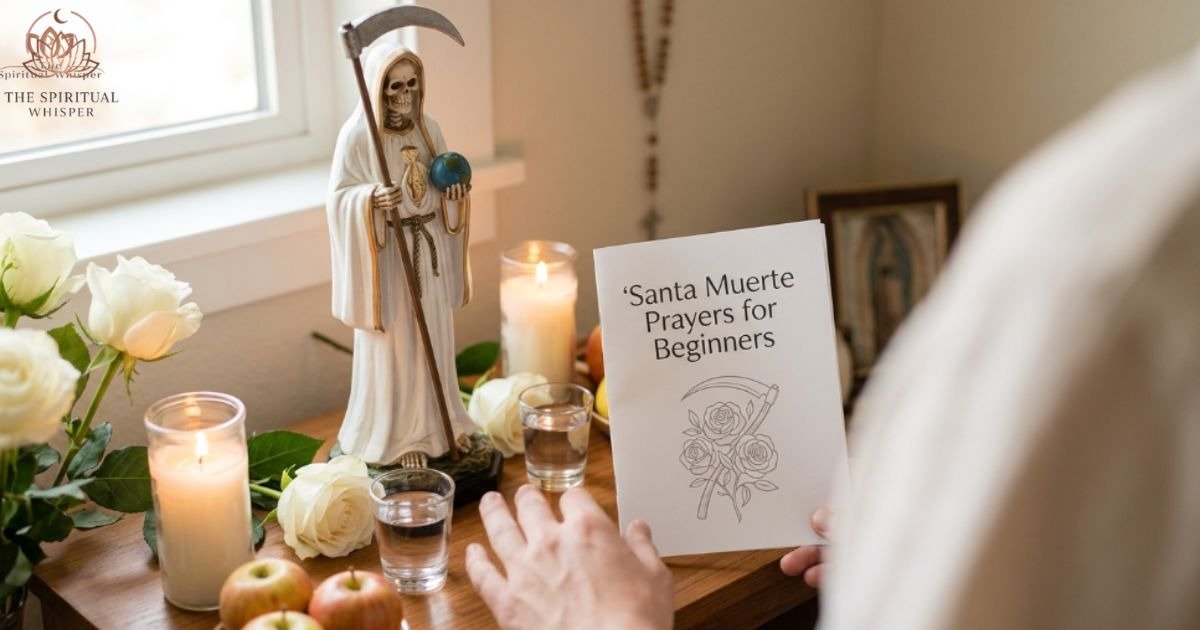
Her imagery commonly includes:
- A skeletal figure wearing a robe
- A scythe
- A globe
- Scales
- Different colored robes or candles
- Roses, flowers, water, and other offerings
The symbolism can vary considerably. A particular color or object may carry one meaning for one devotee and another meaning elsewhere.
Is Santa Muerte a Catholic Saint?
No. Santa Muerte is not an officially recognized saint in the Roman Catholic Church.
Some devotees combine Catholic prayers, saints, crosses, biblical language, and other Catholic symbols with Santa Muerte devotion. Researchers have documented this blending of popular Catholic practices with other cultural and religious traditions.
That distinction matters for beginners. Calling Santa Muerte a “saint” describes how devotees may understand or address her; it does not mean that the Catholic Church has canonized her.
Santa Muerte devotion also does not have one central authority that determines exactly how every follower should pray. Academic research describes considerable diversity in prayers, altars, offerings, and devotional practices.
How Do Beginners Pray to Santa Muerte?
The simplest approach is to pray respectfully and honestly.
You can begin with a quiet moment, address Santa Muerte using the name you prefer, explain what concerns you, and make your request clearly. Some devotional traditions also incorporate Christian prayers such as the Our Father and the Sign of the Cross. Other devotees use spontaneous words from the heart.
A simple beginner routine can look like this:
- Find a quiet place.
- Take a moment to become calm.
- Address Santa Muerte respectfully.
- State your concern or request.
- Ask for protection or guidance.
- Give thanks.
- End the prayer peacefully.
You do not need to make dramatic promises or complicated ritual commitments simply because you are beginning.
A Simple Santa Muerte Prayer for Beginners
If you want an easy starting point, you can use an original prayer such as this:
Santa Muerte, I come before you with respect and an honest heart. Please watch over me as I face the difficulties in my life. Give me courage to make wise choices, protection from harm, and clarity when I feel uncertain. Help me walk with responsibility and gratitude. May I treat others with compassion and remain mindful of the consequences of my actions. Amen.
This prayer is intentionally simple. It does not require special objects, candles, or a particular day.
For beginners, speaking naturally can be just as meaningful as memorizing a long devotional text. Research on Santa Muerte devotion has documented how devotees may speak to the figure with the intimacy they would use with a close spiritual companion.
Santa Muerte Prayer for Protection
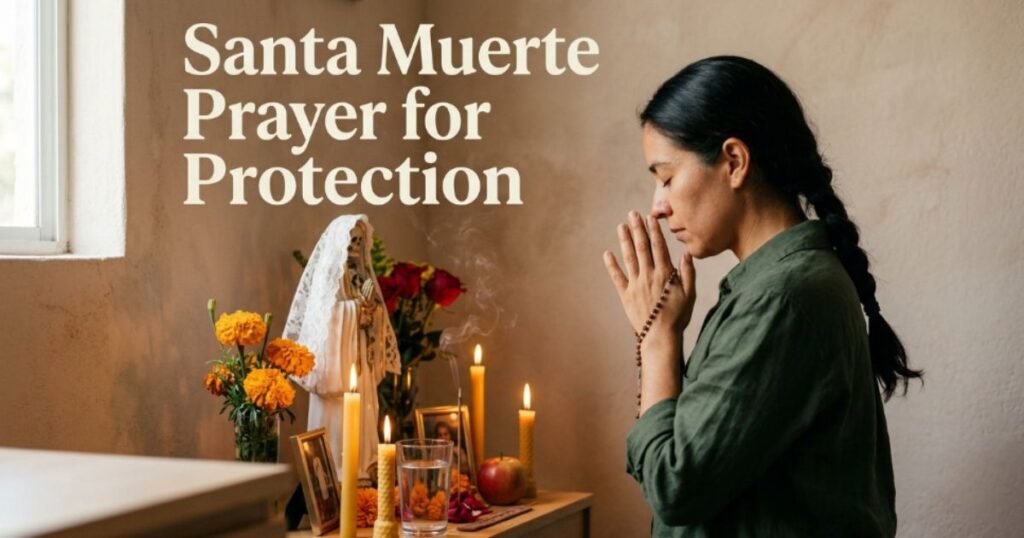
Protection is one of the themes frequently associated with Santa Muerte Prayers devotion. Scholars studying altars and devotional practices have found protection and assistance to be important elements of the tradition.
Here is a simple original prayer for that purpose:
Santa Muerte, guardian of those who call upon you, hear my prayer for protection. Keep me alert to danger and help me avoid choices that could bring harm. Give me courage when I am afraid and wisdom when I must decide what to do. May I move through each day with care, responsibility, and peace. Amen.
This wording presents protection as a devotional request rather than a promise that nothing bad can happen.
Santa Muerte Prayer for Guidance
Prayer does not always have to ask for a specific material favor. A beginner may simply ask for wisdom and direction.
Santa Muerte, I ask for guidance as I face the decisions before me. Help me recognize what is wise, what is harmful, and what deserves my attention. Give me patience when answers do not come quickly. Help me accept responsibility for my choices and move forward with a clear mind. Amen.
This type of prayer can be especially useful when you are uncertain about relationships, work, family matters, or a difficult personal decision.
Santa Muerte Prayer for Healing
Some devotional practices associate Santa Muerte Prayers with healing and relief from suffering. Historical and ethnographic studies have documented petitions involving health and assistance among devotees.
A beginner-friendly prayer could say:
Santa Muerte, I bring my concerns for healing before you. Please give me strength while I face illness, pain, or fear. Help me remain hopeful and make responsible choices about my health. Give comfort to those who care for me, and guide me toward the help I need. Amen.
Prayer should not replace professional medical care. If you are sick or injured, seek appropriate medical attention rather than relying on prayer alone.
Santa Muerte Prayer for Family
Devotees may also pray for people they love.
Santa Muerte, please watch over my family and the people close to my heart. Keep them safe from unnecessary harm and help us treat one another with patience and respect. Give us wisdom when we disagree and strength when we face hardship. May our home be guided by compassion, honesty, and peace. Amen.
You can mention specific family members in your own words if that feels appropriate.
Santa Muerte Prayer for Difficult Times
Some people turn toward devotional practices during periods of uncertainty, grief, financial pressure, danger, or emotional hardship. Researchers have connected the growth of Santa Muerte devotion with broader experiences of insecurity and social uncertainty, although individual reasons for devotion vary.
A simple prayer can focus on endurance rather than demanding a particular outcome:
Santa Muerte, I am going through a difficult season and I need strength. Help me face today’s problems without losing hope. Give me patience, courage, and clear judgment. Help me recognize the people and opportunities that can support me, and give me the strength to take the next responsible step. Amen.
Do Beginners Need an Altar?
No universal rule requires a beginner to have an altar.
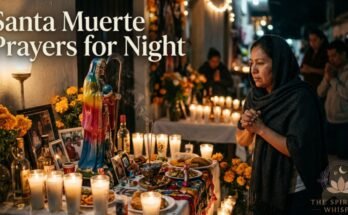
Some devotees create personal altars containing an image or statue, water, candles, flowers, and other offerings. Ethnographic research has documented the importance of altars and personal care of Santa Muerte images within devotional practice.
A simple devotional space might contain:
- A Santa Muerte image or statue, if desired
- A clean glass of water
- Flowers
- A candle used safely
- A small personal devotional item
You can also pray without an altar.
If you use candles, never leave an open flame unattended. A devotional practice should not create a preventable fire risk.
What Do the Colors Mean?
Santa Muerte Prayers imagery often uses different robe and candle colors. However, there is no single universal color system accepted by every devotee.
Meanings commonly associated with colors may include:
| Color | Commonly associated theme |
| White | Peace, cleansing, protection |
| Red | Love, relationships, passion |
| Green | Money, prosperity, justice |
| Gold | Prosperity and abundance |
| Black | Protection, strength, or defense |
| Purple | Spiritual matters and transformation |
These associations should be treated as devotional conventions rather than fixed religious laws.
A beginner does not need to purchase a particular color before praying.
Do You Need Candles to Pray?
No.
Some devotional traditions use candles as part of prayer and altar practice, but Santa Muerte Prayers does not depend on having a particular candle. Community practices vary, and researchers have documented considerable diversity in Santa Muerte devotion.
If you choose to use one, select a candle that fits your purpose and use it safely. An electric candle can also provide a safer alternative where an open flame is unsuitable.
The important distinction is between a devotional symbol and a guaranteed supernatural mechanism. A candle can help establish a prayerful setting, but there is no reliable basis for claiming that a particular candle guarantees a particular result.
What Are Santa Muerte Offerings?
Offerings are part of some Santa Muerte Prayers devotional practices. Academic research describes devotees caring for images and presenting items such as flowers, food, beverages, tobacco, and other gifts.
Offerings can represent gratitude, affection, respect, or reciprocity within a devotee’s understanding of the relationship.
Commonly reported offerings include:
- Fresh flowers
- Water
- Fruit
- Sweets
- Food
- Personal devotional items
Practices vary widely, so beginners should avoid assuming that every offering is required.
Do not leave perishable food or other materials in ways that could create pests, mold, or other household problems.
What Is a Santa Muerte Novena?
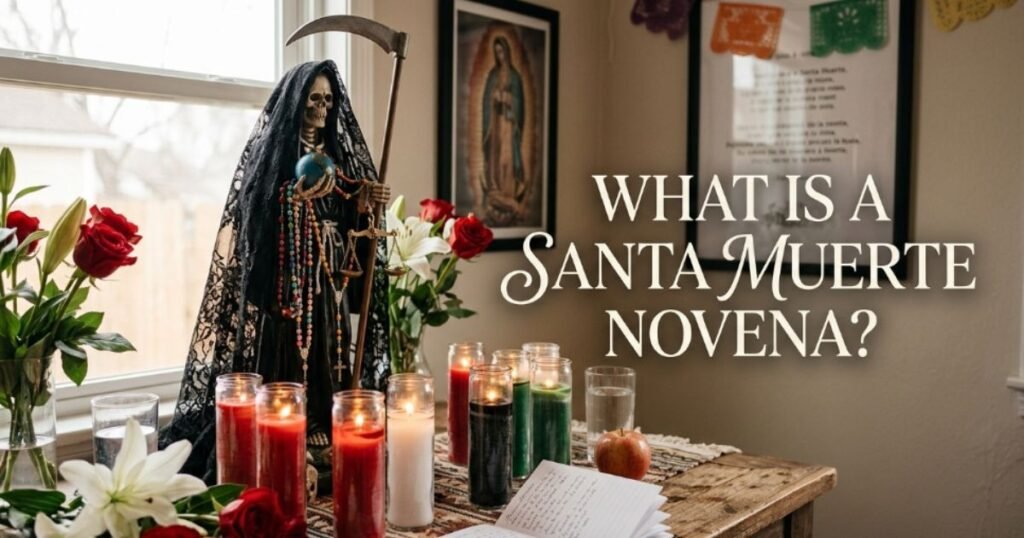
A novena is a devotional practice involving prayer over nine days.
Some Santa Muerte Prayers devotees use nine-day prayer cycles for particular intentions. Existing devotional materials include novenas with daily prayers and specific petitions. However, Santa Muerte devotion does not have one universally standardized novena followed by all devotees.
A beginner can keep a nine-day practice simple:
Days 1–9
- Begin with a moment of silence.
- State your intention.
- Say your chosen prayer.
- Spend a few minutes reflecting.
- Give thanks.
- End respectfully.
You can use the same original prayer each day or write a different Santa Muerte Prayers around the same intention.
The value of a novena comes from sustained devotion and reflection, not from treating nine days as a guaranteed formula for receiving a request.
Can You Pray in Your Own Words?
Yes, many devotional practices allow personal prayer.
Research on Santa Muerte Prayers devotion describes individualized prayer and intimate communication with the figure. Some contemporary devotional communities also explicitly encourage speaking from the heart alongside established prayers.
A personal prayer can be as simple as:
Santa Muerte, you know what I am facing. I ask for your protection and guidance. Help me remain calm, act wisely, and accept responsibility for my choices. I am grateful for the strength to continue. Amen.
You can adapt the wording to your own situation.
Can You Use Christian Prayers?
Some Santa Muerte Prayers devotees incorporate Christian prayers and symbols into their devotional practices.
Academic research has documented the strong presence of Catholic forms and language within some expressions of Santa Muerte devotion, while also emphasizing that the tradition is diverse.
For example, a person may begin or end a personal prayer with the Our Father, a Sign of the Cross, or another Christian prayer.
However, this does not mean that Santa Muerte devotion forms part of official Roman Catholic worship. The two should not be treated as identical traditions.
What Should Beginners Avoid?
Beginners can approach Santa Muerte Prayers devotion thoughtfully by avoiding exaggerated claims and pressure to perform complicated rituals.
Be cautious about anyone who tells you that:
- A particular prayer guarantees money or love.
- You must pay for spiritual protection.
- A specific ritual guarantees a supernatural result.
- You will suffer supernatural punishment if you stop praying.
- You must perform dangerous rituals.
- You should harm yourself or another person.
- You should ignore medical, legal, or professional advice.
- A particular object is absolutely required for devotion.
There is no single central authority that establishes one universal practice for all Santa Muerte Prayersdevotees. Research instead shows a plural and evolving devotional tradition.
Is Santa Muerte Connected to Criminal Activity?
Santa Muerte is sometimes portrayed in media coverage as exclusively connected with organized crime. Scholars have cautioned against reducing the entire devotion to that association.
Research has documented connections between Santa Muerte imagery and some criminal or marginalized settings, but it also describes devotion among broader groups of people and emphasizes the diversity of devotees and practices.
For that reason, it is more accurate to discuss the tradition in its cultural and religious complexity rather than assume that every devotee shares the same background or purpose.
A Simple Beginner Prayer Routine
If you want to begin without complicated rituals, use a short routine that you can understand and follow consistently.
1. Prepare a quiet space.
You can sit at an altar or simply find a peaceful place.
2. Set your intention.
Know what you want to pray about before beginning.
3. Speak respectfully.
Use your preferred name for Santa Muerte.
4. Make your request.
Be specific without demanding a guaranteed result.
5. Add personal words.
Explain your fears, hopes, gratitude, or uncertainty.
6. Give thanks.
End by expressing gratitude for the opportunity to pray.
7. Close safely.
If you used a candle, extinguish it safely before leaving the area.
This approach keeps the practice accessible while avoiding unnecessary complexity.
What Should a Beginner Pray For?
There is no universal list of acceptable intentions. Common themes documented in Santa Muerte Prayers devotion include protection, health, justice, assistance, and support during difficult circumstances.
You might choose an intention such as:
- Protection during a difficult period
- Wisdom before an important decision
- Strength during hardship
- Healing and comfort
- Family well-being
- Gratitude
- Guidance
- Help with fear or uncertainty
- Peace after a difficult experience
When your prayer involves another person, it is better to focus on your own choices and well-being than on trying to control that person’s free will.
Frequently Asked Questions
How to begin praying to Santa Muerte?
Begin by finding a quiet place, speaking respectfully, and clearly expressing your intention or request. You can pray in your own words without needing a complicated ritual.
How do I talk to Santa Muerte?
Speak to Santa Muerte sincerely and respectfully, using your own words to share your concerns, hopes, or gratitude. A formal prayer is not required.
How to end a prayer to Santa Muerte?
You can end by expressing thanks and respectfully closing your prayer, such as, “Thank you for hearing my prayer. May I continue with wisdom and peace. Amen.”
How to pray to Santa Muerte without an altar?
You can pray anywhere quietly without an altar, statue, or special objects. Simply focus your thoughts, speak your prayer sincerely, and finish with gratitude.
Final thoughts
The most important thing is to understand what you are practicing. Santa Muerte Prayers devotion is a diverse form of popular religious devotion with strong Mexican cultural roots and connections to Catholic and other traditions. Its history, symbolism, and rituals are more complex than the simplified images often presented online.
If you choose to explore the tradition, learn from reliable cultural and academic sources, distinguish established practices from individual claims, and approach prayer thoughtfully rather than expecting guaranteed results.