
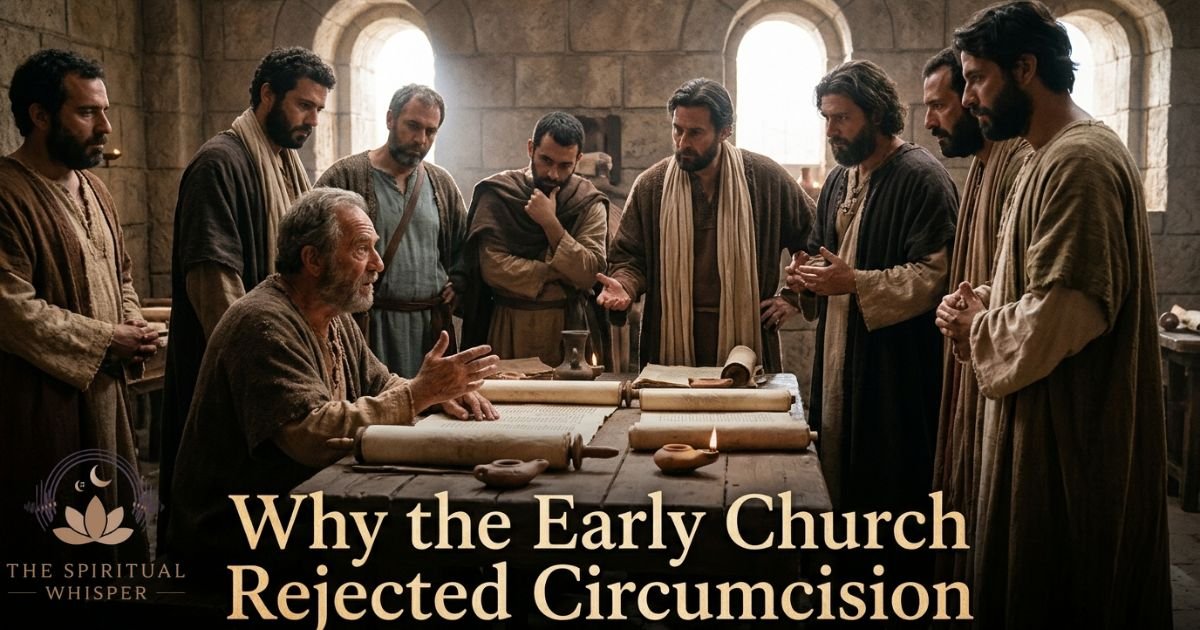
Why the early church rejected circumcision comes down to the gospel. At the Jerusalem Council, the apostles ruled that salvation comes by grace through faith in Jesus, not by the Mosaic law. God had already given the Holy Spirit to uncircumcised Gentiles, so the church would not add a requirement God had not made. Gentile believers did not need to become Jews to belong to Christ.
This question matters because it shapes how we understand grace today. Many believers still wonder if faith needs extra rules to be real. The story in Acts 15 gives a clear and hopeful answer. It also shows how the church handled a painful disagreement with prayer and Scripture. Seeing why the early church rejected circumcision helps us stand firm in the gospel.
The Background: How the Gentile Question Emerged
The Gentile question began long before the Jerusalem Council. It started when God opened the door of faith to non-Jews, one household at a time. Knowing that story helps us see why the debate felt so urgent, and why the church handled it so carefully.
“…the gift of the Holy Spirit was poured out even on the Gentiles.” — Acts 10:45 (ESV)
Jesus told His followers to make disciples of all nations (Matthew 28:19). Still, the first believers were Jewish, and they kept Jewish customs. Then God sent Peter to Cornelius, a Roman centurion who feared God. While Peter spoke, the Holy Spirit fell on Cornelius and his household, and they received the Spirit before anyone baptized them (Acts 10:44–48).
Peter’s friends could hardly believe it. When Peter reported back in Jerusalem, the church praised God (Acts 11:18). Soon after, believers in Antioch shared Jesus with Greeks, and many believed (Acts 11:20–21). Paul and Barnabas then carried the gospel to more Gentile towns. That growth raised a big question: must these new believers also become Jews? This is where the story of why the early church rejected circumcision begins.
Lord Jesus, thank You for opening the door of faith to every nation. I was once outside, and You welcomed me in by grace. Keep my heart open to those who look different from me. Teach me to rejoice when You save people I did not expect. Your welcome is wider than I can imagine. Let me never close a door that you have opened. Amen.
The Dispute That Led to the Jerusalem Council
Trouble arrived in Antioch when some teachers came from Judea. They taught a message that sounded religious but changed the gospel. Paul and Barnabas could not stay silent, so they pressed the matter until the church leaders met.
“But some men came down from Judea and were teaching the brothers, ‘Unless you are circumcised according to the custom of Moses, you cannot be saved.’” — Acts 15:1 (ESV)
Luke says these men told Gentile believers they could not be saved without circumcision. Paul and Barnabas disagreed sharply and argued with them. So the church in Antioch sent Paul, Barnabas, and others to Jerusalem to settle the question with the apostles and elders (Acts 15:2).
Some believers from the party of the Pharisees pressed the point further. They said Gentiles must keep the law of Moses (Acts 15:5). Notice what this dispute was about. It was not a matter of taste. It asked whether faith in Christ was enough. Why the early church rejected circumcision depends on how the apostles answered that.
God of truth, I do not like conflict, yet I know disagreements will come. When they do, keep me from anger and pride. Give me courage to stand on Your gospel and gentleness to speak with love. Show me what is essential and what is only preference. Lead Your church to seek You first, as the believers in Jerusalem did. Amen.
Why Circumcision Was Such an Important Issue
Circumcision was not a small custom to the first Jewish believers. It carried the weight of God’s promise to Abraham and the law of Moses. To feel their concern, we need to see what circumcision meant in Scripture.
“Every male among you shall be circumcised.” — Genesis 17:10 (ESV)
God gave circumcision to Abraham as a sign of His covenant (Genesis 17:9–14). Every male in Abraham’s household received it, including servants born in his house or bought from foreigners. Later the law of Moses repeated the command (Leviticus 12:3). For centuries, it marked who belonged to God’s people.
So the Jewish believers asked a fair question. If Gentiles join God’s family, should they not take the covenant sign? The apostles answered no, and Scripture had already pointed the way. The prophets spoke of a circumcised heart (Deuteronomy 30:6; Jeremiah 4:4), and Paul said true circumcision happens in the heart, by the Spirit (Romans 2:29). God promised that new-heart work in the new covenant. You can read more about the New Covenant and its significance for Christian faith. Seeing this helps explain why the early church rejected circumcision without rejecting God’s Word.
Lord, search my heart today. I do not want a faith that looks right on the outside but stays cold inside. Do the deep work only You can do. Soften what is hard in me and make me new by Your Spirit. Thank You that You look at the heart, not at labels. Keep me close to You, and let my life show real love for You. Amen.
Peter’s Argument: God Makes No Distinction Between Jew and Gentile
When the debate grew heated, Peter stood up and spoke from experience. He did not start with theory. He started with what God had done in Cornelius’s house, and he let that story carry the argument.
“…he made no distinction between us and them, having cleansed their hearts by faith.” — Acts 15:9 (ESV)
Peter reminded the council that God chose him to bring the gospel to the Gentiles (Acts 15:7). God knew their hearts, and He gave them the Holy Spirit just as He had given the Spirit to the Jewish believers (Acts 15:8). Then Peter made his main point. God made no distinction, because He cleansed their hearts by faith.
Next, Peter asked why anyone would test God by placing a yoke on the Gentiles that neither their fathers nor they could bear (Acts 15:10). That was a strong statement from a Jewish apostle. He ended with the heart of the gospel. Jews and Gentiles are saved the same way, through the grace of the Lord Jesus (Acts 15:11). Peter put Jews in the same boat as Gentiles, because everyone needs grace. This is why the early church rejected circumcision as a requirement.
Faithful God, I stand on grace alone. I cannot earn my place with You by my effort, my background, or my good record. You saved me because You are kind, and You cleansed my heart by faith. Help me remember this when I feel unworthy or proud. I trust Jesus, and I rest in what He finished for me. Amen.
Paul’s and Barnabas’s Testimony Among the Gentiles
After Peter spoke, the whole assembly grew quiet. Next came two men who had seen God work among Gentiles in distant towns. Their stories gave the council fresh proof that God had already welcomed these believers.
“…they listened to Barnabas and Paul as they related what signs and wonders God had done through them among the Gentiles.” — Acts 15:12 (ESV)
Barnabas and Paul did not argue from tradition. They simply told what God had done. On their first journey, they had seen people turn to Christ in Cyprus, Pisidian Antioch, Iconium, Lystra, and Derbe (Acts 13–14). They had told the church in Antioch that God had opened a door of faith to the Gentiles (Acts 14:27).
Their testimony mattered because it matched Peter’s. Two different witnesses told the same story. God worked through Peter in Caesarea, and He worked through Paul and Barnabas across Asia Minor. In this way, the church saw a clear pattern. God was not waiting for Gentiles to become Jews first. He was already saving them.
Father, for every story of Your grace, I give You thanks. Thank You for missionaries, pastors, and ordinary friends who tell what You have done. Let my own story speak plainly of Your kindness. Open my mouth when someone needs to hear it. Bless believers who serve in far places, and give them joy and strength. May many hearts turn to You. Amen.
James’s Argument: The Prophecy of Amos 9
James, the leader of the Jerusalem church, spoke last. He did not rely on feelings or on one story alone. He turned to the prophets and showed that Scripture had always planned for the Gentiles to come to God.
“…we should not trouble those of the Gentiles who turn to God.” — Acts 15:19 (ESV)
James began by agreeing with Peter (Acts 15:14). Then he said the words of the prophets agree with what happened, and he quoted Amos 9:11–12. In that passage, God promises to rebuild David’s fallen tent so that the rest of mankind may seek the Lord, including all the Gentiles called by His name (Acts 15:16–17).
This mattered a great deal. James showed that Gentiles coming to God was no surprise or accident. It fit God’s plan. Acts quotes Amos in a form that matches the early Greek translation of the Old Testament, which many Greek-speaking believers used. The prophets help explain why the early church rejected circumcision. Based on them, James gave his judgment: do not trouble Gentiles who turn to God.
Lord of all nations, You keep every promise You make. Long before Jesus came, You spoke of Gentiles seeking You, and You brought it to pass. I praise You for Your faithful plan. Thank You that I belong to Your family. Give me trust when I cannot see how You will fulfill Your Word, and keep me steady until I see it. Amen.
The Four Requirements Given to Gentile Believers
The council freed Gentiles from circumcision, but it did not leave them without guidance. James proposed four simple requirements. Each one had a clear purpose, and together they helped Jewish and Gentile believers share meals and worship in peace.
“…but should write to them to abstain from the things polluted by idols, and from sexual immorality, and from what has been strangled, and from blood.” — Acts 15:20 (ESV)
Scholars explain these four requirements in more than one way. Some see a link to Leviticus 17–18, which gave rules for foreigners living among Israel. Others stress the need for shared meals. Either way, none of the four was a condition for salvation. They were guidance for living together as one family.
1) Abstaining from things polluted by idols
Many meats sold in Gentile cities came from pagan temples. Eating at an idol feast meant joining in false worship. Paul later told believers to flee idolatry (1 Corinthians 10:14). The council wanted Gentile believers to make a clean break from the worship they once practiced.
2) Abstaining from sexual immorality
Some pagan worship treated sexual sin as normal, and even as part of religion. The council made clear that Gentile believers must follow God’s moral standard. Unlike the food rules, this command touches lasting moral truth, and the New Testament repeats it (1 Corinthians 6:18).
3) Abstaining from things strangled
Strangled animals still had their blood in the meat. Jewish believers had long avoided such meat because the law linked life with blood (Leviticus 17:13–14). The council asked Gentiles to respect this concern. That way, Jewish and Gentile believers could eat together without offense.
4) Abstaining from blood
God told Noah that life is in the blood (Genesis 9:4), and the law repeated this (Leviticus 17:10–12). By avoiding blood, Gentile believers honored a very old command given long before Moses. It also showed respect for their Jewish brothers and sisters.
Dear Lord, You care about how your people live and how we love each other. Show me where I need to turn away from old habits and false gods. Give me a willing heart to honor those who share my pew but see some things differently. Let me choose love over my own comfort. Keep our church united, patient, and pure in Your sight. Amen.
Did the Council Replace the Ten Commandments With Four Rules?
Some readers ask whether the council quietly erased God’s moral law. It did not. The four requirements gave a starting point for new believers, not a full list of Christian duty. A close look at the text shows why.
“And his commandments are not burdensome.” — 1 John 5:3 (ESV)
First, the letter says the council wanted to lay no greater burden on the Gentiles than these requirements (Acts 15:28). That sentence deals with this specific dispute. It does not say Gentiles could ignore God’s moral will.
Second, James pointed out that Moses had been preached in every city and read in the synagogues every Sabbath (Acts 15:21). Gentile believers would keep hearing and learning God’s Word. Third, the apostles later taught moral law to Gentile churches. For example, Paul told the Ephesians to honor their parents and quoted the commandment (Ephesians 6:1–3). Understanding why the early church rejected circumcision does not mean the council swapped ten commandments for four rules. It answered one question: do Gentiles need circumcision to be saved? The answer was no.
Gracious God, thank You for Your good law and Your better grace. Teach me to love what You love. Where I treat Your commands as a cage, show me they come from a Father who cares. Write Your ways on my heart, and let obedience grow from love, not fear. Keep me from both pride and carelessness as I follow Jesus. Amen.
The Council’s Letter and the Authority of Its Decision
After the speeches, the church put the decision in writing. The letter carried real weight, and it brought encouragement to the Gentile believers who received it. It also shows how the church worked together under the Spirit’s guidance.
“For it has seemed good to the Holy Spirit and to us to lay on you no greater burden than these requirements…” — Acts 15:28 (ESV)
The apostles and elders, with the whole church, chose Judas Barsabbas and Silas to carry the letter to Antioch with Paul and Barnabas (Acts 15:22). The letter greeted Gentile believers in Antioch, Syria, and Cilicia (Acts 15:23). It said the men who troubled them had not received instructions from Jerusalem (Acts 15:24).
The letter also spoke with humble authority. It seemed good to the Holy Spirit and to the church. The leaders did not vote on their own wishes. They listened to Scripture, to testimony, and to the Spirit. When the believers in Antioch read the letter, they rejoiced because of its encouragement (Acts 15:31). The decision brought relief, not a new burden. You can read the whole account in Acts 15 on BibleGateway.
Holy Spirit, You guided the early church, and I ask You to guide Your church today. When leaders face hard choices, give them wisdom and humility. Help us listen to Scripture, to each other, and to You. Keep us from pride and quarrels. Making our decisions brings comfort and joy to others, just as that letter did in Antioch. Amen.
The Relationship Between Acts 15 and Paul’s Teaching in Galatians
Some readers compare Acts 15 with Galatians and wonder if the two accounts clash. They do not. Both passages protect the same truth, and Paul’s letter shows how fiercely he defended it when others pressed Gentile believers to submit to the law.
“For in Christ Jesus neither circumcision nor uncircumcision counts for anything, but only faith working through love.” — Galatians 5:6 (ESV)
In Galatians 2, Paul tells how he went up to Jerusalem with Barnabas and Titus. Titus, a Greek, was not forced to be circumcised (Galatians 2:3). The leaders added nothing to Paul’s message and gave him and Barnabas the right hand of fellowship (Galatians 2:6–9). Many scholars link this visit with the council in Acts 15, while others connect it to an earlier visit. Either way, the outcome matches.
The two accounts fit together. Acts shows the public meeting and the decision. Galatians shows Paul’s personal stake and his passion. In both, Gentiles stand free from circumcision as a requirement. Paul warned that anyone who accepts circumcision as a way to be right with God must keep the whole law (Galatians 5:3). That warning helps explain why the early church rejected circumcision. The issue was never the act itself. It was trust in Christ alone.
Jesus, You set me free, and I do not want to trade freedom for fear. Whenever I feel pressure to prove myself, remind me that faith working through love is enough. Thank You for finishing the work on the cross. Teach me to rest in what You have done and to love others freely. Let my life show Your grace. Amen.
What Happened After the Jerusalem Council?
The council settled the question, but the church still had to live it out. Letters traveled, churches grew, and some tensions remained. Real life is never as tidy as a ruling, and the story after Acts 15 shows both victory and ongoing care.
“So the churches were strengthened in the faith, and they increased in numbers daily.” — Acts 16:5 (ESV)
Paul and Silas carried the decision from town to town and gave it to the churches to follow (Acts 16:4). As a result, the churches grew stronger in faith and larger in number every day. The letter did not divide the church. It strengthened it.
Some questions stayed lively, though. Paul circumcised Timothy, whose mother was Jewish, so he could minister among Jews without hindrance (Acts 16:1–3). Paul did not do this to earn salvation. In contrast, he refused to circumcise Titus when some demanded it as a requirement (Galatians 2:3–5). Scholars at Bible Odyssey note that the question kept surfacing for generations. Even so, most later Christian writers rejected the need for Gentile circumcision.
Lord, thank You that Your church keeps going, even when disagreements linger. I pray for believers who still feel pressure to earn Your love. Break every chain of legalism and doubt. Strengthen small churches and new Christians, and help them grow day by day. Keep me faithful when old questions come back. I trust You to finish the good work You began. Amen.
The Significance of the Jerusalem Council for Christians Today
Acts 15 is not only ancient history. The reasons why the early church rejected circumcision still guide Christians who face pressure to add rules to the gospel or to divide over background. Five lessons stand out, and each one helps us live with grace and clarity.
“For by grace you have been saved through faith.” — Ephesians 2:8 (ESV)
Salvation is not earned through religious identity.
No family line, church membership, or ritual saves us. Jesus does. Paul reminds believers that salvation is God’s gift, not a result of works (Ephesians 2:8–9). Trust in Christ, not in a badge, makes someone a child of God.
The gospel must not be burdened with requirements God has not made conditions of salvation.
When people add conditions to grace, the good news grows heavy. The council refused to do that, and we should refuse too. Teach new believers to follow Jesus, but never tell them God’s love depends on extra requirements He has not given.
Christian freedom does not eliminate moral responsibility.
The council still asked Gentiles to flee idolatry and sexual sin. Paul later said God called us to freedom, but we must not use it as an excuse for sin. Instead, we serve one another through love (Galatians 5:13). Grace teaches us to say yes to God.
The church must take Scripture seriously when resolving disagreements.
The council did not decide by power or popularity. The leaders listened to testimony and tested it against the prophets (Acts 15:15). Churches today can do the same. Pray, study the Bible, listen patiently, and then speak with one voice.
Unity does not require every believer to share the same ethnic or cultural background.
Jews and Gentiles stood together as one family in Christ (Galatians 3:28). Churches can honor different cultures and still share one faith. We do not need sameness to have oneness.
Father of all nations, make Your church a place where every person finds welcome. Break down walls of pride and background. Teach us to hold to the gospel firmly and to treat each other gently. Let our love for You overflow into love for neighbors near and far. May the world see the unity that only Jesus can give. Amen.
Frequently Asked Questions
Why did the early church reject circumcision for Gentile believers?
The apostles saw that God gave the Holy Spirit to uncircumcised Gentiles by faith. Peter said God made no distinction between Jews and Gentiles. So the answer to why the early church rejected circumcision is simple: grace through faith in Jesus saves, not the law.
What did the Jerusalem Council decide about Gentile believers?
The council decided Gentiles did not need circumcision to be saved. It asked them to avoid food polluted by idols, sexual immorality, strangled meat, and blood. The letter also said the church wanted to lay no greater burden on them than these requirements.
Does Christianity still require circumcision?
No. Paul teaches that neither circumcision nor uncircumcision counts for anything in Christ, but faith working through love does (Galatians 5:6). Some people choose it for medical or cultural reasons, but no one needs it to be saved or to belong to God’s family.
Why did Paul circumcise Timothy but not Titus?
Timothy’s mother was Jewish, and Paul circumcised him so he could minister among Jews without hindrance (Acts 16:3). Titus was Greek, and some demanded his circumcision as a requirement. Paul refused, because that would deny the gospel of grace (Galatians 2:3–5).
Was circumcision ever required by God?
Yes, for Abraham’s household and later for Israel under the law (Genesis 17:10; Leviticus 12:3). It was a sign of God’s covenant. In Christ, the sign points to a changed heart, and the New Testament teaches that faith, not circumcision, marks God’s people.
Conclusion
Why the early church rejected circumcision gives us one of the clearest pictures of grace in the New Testament. God gave His Spirit to Gentile believers by faith, and the apostles refused to add a requirement He had not given. Jesus alone saves, and no ritual, background, or effort can improve on His finished work.
If you ever feel pressure to earn God’s love, remember Acts 15. The same Savior who welcomed Cornelius welcomes you. Walk in freedom, love others well, and keep growing in His Word. You can explore more faith resources as you study. May God’s grace fill your heart and steady your steps today.